
Your body burns most of its daily calories before you take a single step. Breathing, circulating blood, and repairing cells all happen in the background, all day long. The energy those basic functions require is called your Basal Metabolic Rate, or BMR.
Understanding your BMR can help you make more informed nutrition choices, avoid eating too little, and work with your Care Team to find a sustainable balance that supports your goals.
Your body is always working, even at rest
Right now, as you read this, your body is doing a lot behind the scenes. Your heart is pumping blood. Your lungs are pulling in air. Your cells are repairing themselves. Your brain is processing these words.
All of that takes energy. The amount of energy your body needs to keep those basic functions going is your Basal Metabolic Rate, or BMR.
-
Your brain uses about 20% of your resting calories. It helps run memory, mood, hunger signals, and hormone regulation nonstop.
- Your liver uses another 20%. It filters blood, stores energy, and helps process what you eat and drink.
- Digestion uses about 10% of your daily energy. It breaks food down into fuel your body can use.
- Your heart beats about 100,000 times per day, moving oxygen and nutrients to every cell, even while you sleep.
- Your lungs move about 8,000 liters of air each day at 12–20 breaths per minute.
- Your cells turn over at roughly 330 billion per day, replacing blood cells, gut lining, and skin around the clock.
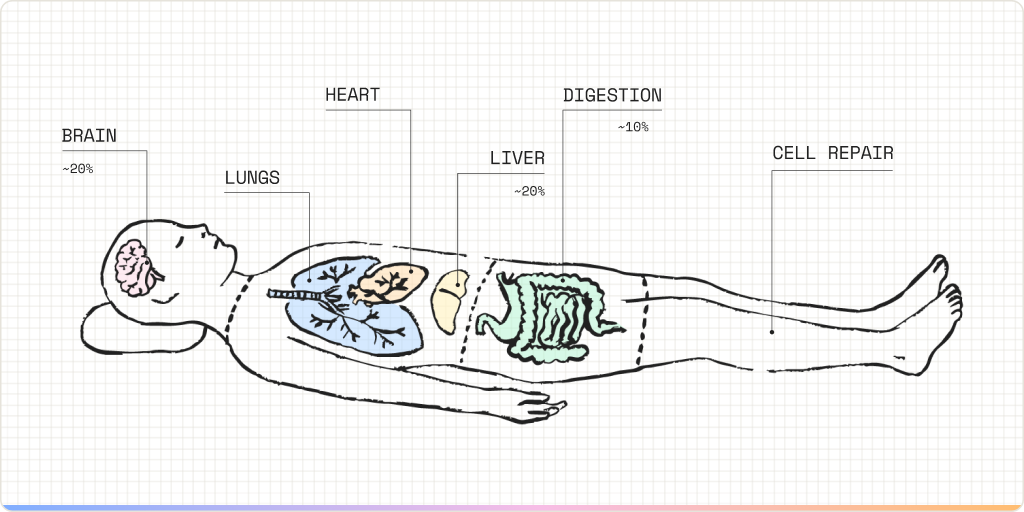
Think of it like the electricity your house uses even when you are not home. The fridge is still running. The thermostat is still working. The clocks are still ticking. Your body has its own version of that baseline power draw, and it accounts for most of the calories you burn each day.
Why your BMR matters for your goals
This number matters because your BMR reflects the minimum amount of fuel your body needs to function at rest. Not to run a mile or get through a busy day, but just to breathe, circulate blood, and keep your organs doing their jobs.
When people try to lose weight by eating as little as possible, they can end up eating below that baseline. That is when things can start to feel harder. When your body consistently gets less fuel than it needs, it adapts. Your energy can drop. Recovery can feel harder. And the habits you are trying to build can become much tougher to maintain.
The goal is not to eat as little as possible. The goal is to find a sustainable balance. That means enough fuel to support your body while still making room for gradual, healthy progress.
What affects your BMR?
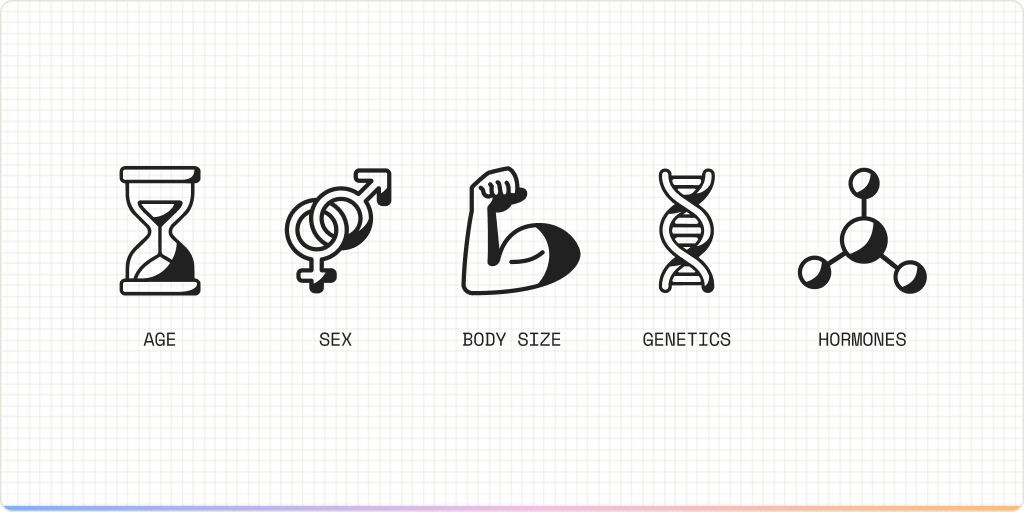
Your BMR is personal, and it is shaped by several factors:
- Age: BMR tends to decrease gradually as you get older. This is partly because of changes in muscle mass and hormone levels.
- Sex: On average, people assigned male at birth tend to have a slightly higher BMR. This is mostly because of differences in body composition.
- Body size and composition: More muscle mass generally means a higher BMR, because muscle tissue requires more energy to maintain than fat tissue.
- Genetics: Some variation in metabolic rate is simply inherited.
- Hormones: Thyroid function plays a significant role in how fast or slow your metabolism runs.
None of these factors are something you need to fix. They are just part of the picture, and a reminder that your number is your own.
How to estimate your BMR
The most common method for estimating BMR is the Mifflin-St Jeor equation. It factors in your age, sex, height, and weight.
Here is the formula:
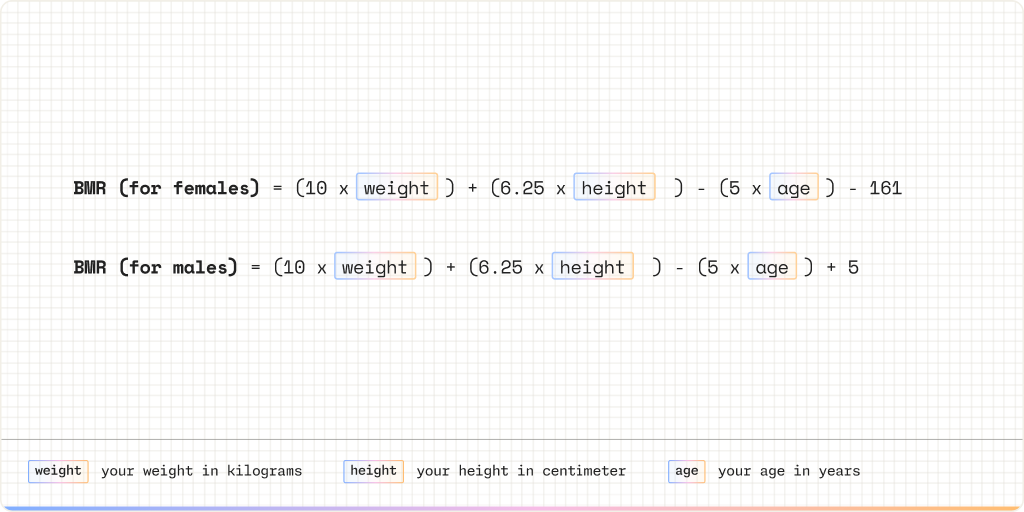
For example: a 45-year-old woman, 5'4" and 160 pounds, has a BMR of about 1,360 calories per day. That is what her body uses at rest, before she even gets out of bed.
A BMR estimate is a starting point, not a prescription. It gives you a general sense of your body's baseline energy needs. It does not capture activity level, medications, stress, sleep, or health conditions.
What to do with your number
Once you have your BMR estimate, you might be wondering what to do next.
Here is the most important takeaway: your BMR is a floor, not a ceiling. It is the minimum your body needs. On top of that, you also need energy for everything else, walking, working, cooking, exercising, and even digesting your food.
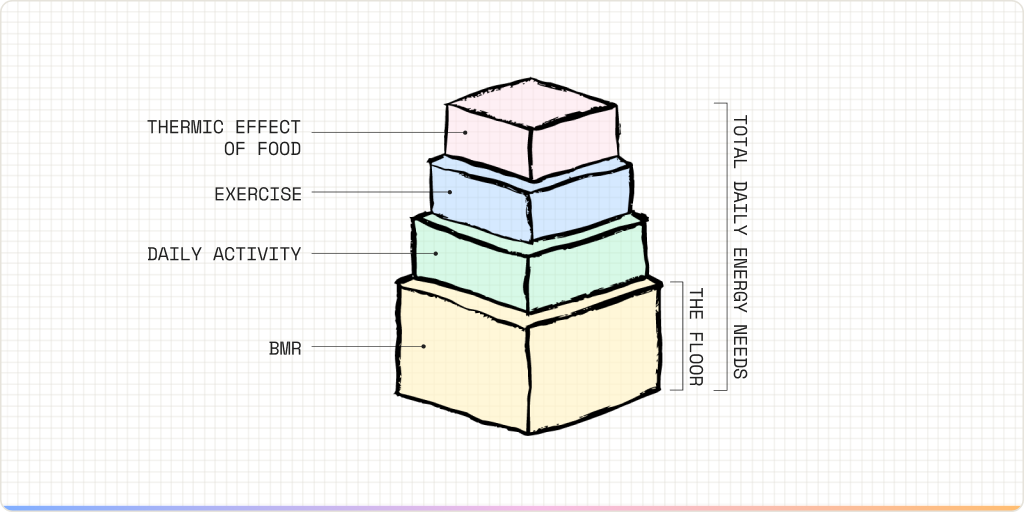
Your total daily energy needs are higher than your BMR. How much higher depends on your routine and activity level.
The important part is not doing the math perfectly. It is understanding the role this number plays. These numbers are guideposts, not rules.
Your Care Team can help you put this together
Understanding your BMR is one piece of a bigger picture. If you have just finished Module 2 of your Healthy Weight Journey, you already have tools to build on: the Plate Method, the basics of macronutrients, and the nutrition goal you wrote for yourself. Your BMR is one more piece of the puzzle.
Your Registered Dietitian can help you:
- Interpret your number in the context of your health, your medications, and your goals
- Set a realistic calorie range that supports your body without leaving you depleted
- Adjust as you go because your needs will shift as your habits, activity level, and body change over time
You are not trying to eat as little as possible. You are trying to eat in a way that gives your body what it needs so you can feel good, have energy, and build habits that last. You do not need to figure this out alone. Send your Care Team a message when you are ready to talk through your next step.
References
Martins, C., et al. (2025). "Metabolic adaptation and weight management." Diseases, 13(2), 55. mdpi.com/2079-9721/13/2/55
Mifflin, M.D., et al. (1990). "A new predictive equation for resting energy expenditure in healthy individuals." American Journal of Clinical Nutrition, 51(2), 241–247. pubmed.ncbi.nlm.nih.gov/2305711
Westerterp, K.R. (1998). "Physical activity and energy balance." Public Health Nutrition, 2(1a). pubmed.ncbi.nlm.nih.gov/10610070
Harvard Health Publishing. "Calories burned in 30 minutes for people of three different weights." health.harvard.edu
About the authors
Recent articles
As your health changes, your medications may change too
What to eat during perimenopause and menopause
Understanding body fat and muscle mass
Get the latest tips to your inbox!
The care your need to feel care-free
9amHealth gives you the tools you need to manage your prediabetes and type 2 diabetes with ease.